
Wood chips are undergoing a transformation in their image and applications. Long perceived as mere sawmill waste, they now fuel biomass boilers, cover schoolyards, and structure mulching strategies in urban environments. What are the uses that are progressing, those that are stagnating, and the parameters to monitor to make the right choice according to one’s needs?
Wood Chips: Comparison of Current Uses by Sector
Wood chips do not all serve the same purposes. Their particle size, species, and treatment vary according to the final destination. The table below summarizes the three main sectors that currently structure the Francophone market.
| Sector | Preferred Type of Chips | Main Function | Recent Trend |
|---|---|---|---|
| Energy (pellets, biomass boilers) | Fine chips and sawdust, softwood or hardwood | Fuel for domestic and collective heating | Increasing demand, rising prices |
| Mulching and gardening | Medium to coarse chips, hardwood | Reduction of watering, soil protection, weed control | Growing adoption in urban and school environments |
| Industry (MDF panels, particleboard) | Calibrated chips, mixed species | Raw material for panels and composites | Structurally growing global market |
What stands out from this breakdown is that the energy sector is capturing an increasing share of the available volumes. Swiss professional organizations in the wood industry noted in 2025 that the price increases for chips and sawdust are among the few positive signals in the market, driven directly by the demand for heating pellets.
To keep up with information on Les Copeaux, several sectors regularly publish reports that allow for comparisons of price trends and volumes exchanged from one season to the next.
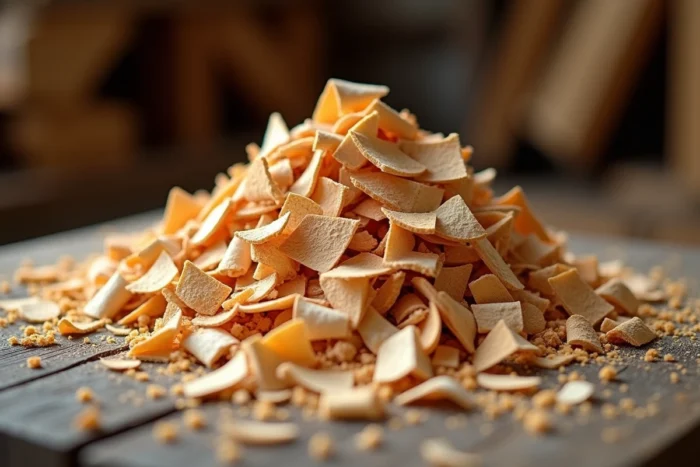
Energy Recovery from Chips: What’s Changing in 2025-2026
Major energy distributors are now communicating about ranges of pellets labeled “zero additional logging,” made solely from sawdust and chips sourced from the wood processing industry. This positioning reflects a fundamental change: chips are no longer waste but a fully-fledged resource in the energy value chain.
The direct consequence for individuals and communities is a strain on supply. Sawmills that used to sell their chips at low prices are seeing competition among buyers (pellet manufacturers, panel makers, landscapers) intensify.
Pellets and Biomass Boilers: Pressure on Volumes
The development of biomass boilers in French urban areas is amplifying this dynamic. Recent projects aim to heat several thousand homes using local chips and flakes. For the managers of these installations, the consistency of supply is as important as the price per cubic meter.
In contrast, the panel sector (MDF, particleboard) absorbs chips of varying quality, often less demanding regarding residual moisture. Therefore, the two sectors do not always compete directly, but they draw from the same source of sawmill by-products.
Wood Chips in Gardening and Urban Development: Emerging Uses
Mulching in gardens is nothing new. What is newer is the integration of wood chips into large-scale urban planning projects, particularly “oasis courtyards” and soil de-sealing operations in schools.
Schoolyards and De-sealing
Recent technical guides from urban planners show that chips serve as permeable coverings in renovated schoolyards. Their function goes beyond mere comfort: they promote rainwater infiltration and contribute to cooling paved areas.
The selection criteria for these uses are specific:
- The particle size must be coarse enough to prevent rapid compaction and ensure permeability over several seasons
- The chosen species (preferably untreated hardwoods) should not release excessive tannins, which could discolor runoff water
- Annual renewal represents a budget item to anticipate, as thickness decreases due to trampling and decomposition
Tick Control: A Validated Use
Studies reported in 2026 confirm the interest in wood chips as a physical barrier against ticks in residential areas. Placed in a band between a lawn and a wooded area, the chips significantly reduce the migration of ticks to play areas. This application remains little known in France, although it is gaining traction in Canada.

Choosing Your Wood Chips: Criteria That Make a Difference
Given the diversity of offerings (recycled pallet chips, raw sawmill chips, forest flakes), the choice relies on a few technical parameters that are often overlooked.
- The origin of the wood determines the potential presence of treatment residues. Chips from pallets may contain traces of phytosanitary products, which should be avoided for food mulching
- The moisture content affects the rate of decomposition. A chip that is too moist promotes mold, while a chip that is too dry decomposes slowly and acidifies the soil
- The size of the chip determines the use: fine for composting or combustion, medium to coarse for durable mulching
- Certification (PEFC, FSC) guarantees responsible forest management, a criterion increasingly demanded by communities in their calls for tenders
A “cheap” chip sourced from untracked reclaimed wood can create more problems (soil contamination, odors, fungal proliferation) than the savings made at purchase. Checking the origin and treatment of the wood remains the most cost-effective precaution.
The wood chip market is gradually structuring itself, driven by the energy transition and urban greening policies. The trade-offs between energy sectors and landscaping uses will continue to impact prices and local availability. Identifying one’s precise need (fuel, mulching, landscaping) before comparing offers remains the most reliable starting point.