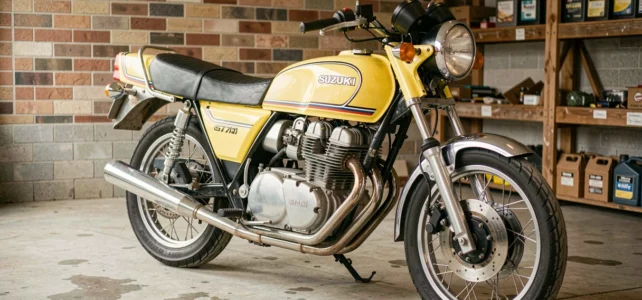
The Suzuki GT 750, produced from 1972 to 1977, is a Japanese touring motorcycle equipped with a 739 cm³ liquid-cooled two-stroke inline three-cylinder engine. This cooling system, rare on production motorcycles at the time, earned it the nickname “bouillotte” in France and “Water Buffalo” in the United States.
The colors and series of this model serve as a technical reference for collectors. The value of a specimen directly depends on the year, the original color, and the integrity of the paint.
Original varnish and survivor paint: what determines the value of a GT 750 today
In the collector’s market, a phenomenon has intensified in recent years: so-called “survivor” specimens, retaining their factory paint, sometimes reach prices higher than those of fully restored motorcycles. The logic may seem paradoxical, but it is based on a specific criterion: the complete traceability of the motorcycle takes precedence over aesthetic perfection.
Purist collectors seek what is called “matching numbers” associated with original paint. A slightly patinated varnish, somewhat dull stripes, or even micro-chips on the tank become proofs of authenticity. A recent restoration, no matter how meticulous, erases this material history and raises doubts about the fidelity of the applied colors.
To precisely identify the colors of each year, the Suzuki GT 750 color guide details the paint codes by year and destination market, an essential tool before any transaction or restoration.
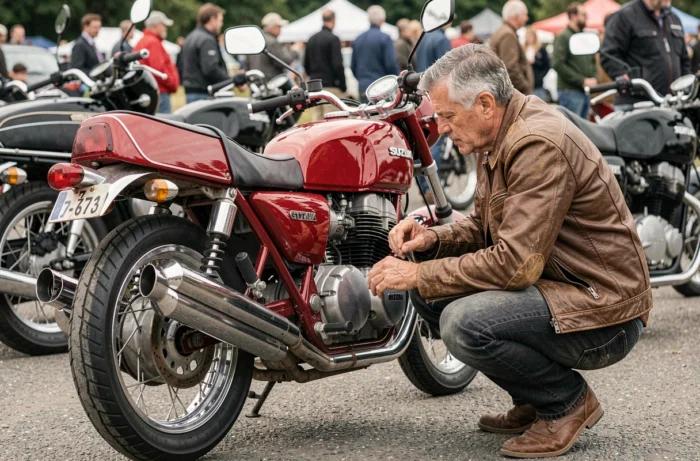
Evolution of GT 750 colors by year: from foundational blue to metallic grays
The color variations of the GT 750 were not trivial. They corresponded to different commercial strategies depending on the markets (Japan, Europe, North America) and visually marked the model’s evolutions.
Early years: deep blues and purples
The J (1972) and K (1973-1974) models primarily featured dark and metallic shades. The blues and purples of the early years are the most emblematic of the GT 750. These colors, combined with the abundant chrome of the frame and fenders, define the image that most enthusiasts have of this motorcycle.
Metallic brown also appeared in the catalog, but in lesser proportions. Examples in this shade are rarer on the current market, which does not automatically mean they are worth more: demand is focused on the blues.
End of production: metallic greens and grays
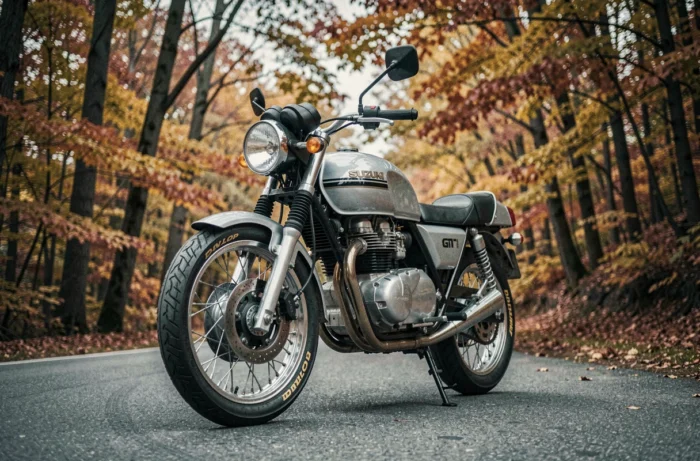
Starting with the L model (1974) and especially the M (1975), A (1976), and B (1976-1977) models, the palette expanded. Greens, metallic grays, and blacks emerged, reflecting the stylistic evolution of the second half of the 1970s. End-of-career shades are often underestimated by buyers, even though they correspond to the most mechanically advanced versions.
Each market received specific variants. A GT 750 sold in Japan could have a shade absent from the European catalog, complicating the identification of models imported later.
Restoration contests: judging criteria on paint
The scoring grids for classic motorcycle contests have tightened regarding colors. Verification of the exact paint code and type of varnish (glossy, metallic, satin) is part of the points systematically checked by judges.
To assess the conformity of a GT 750, judges refer to several types of documents:
- Period commercial catalogs, which show color combinations by year with the official shade names.
- Manufacturer color cards, which provide the reference paint codes used in the factory.
- Press and test photos published between 1972 and 1977, useful for checking nuances and reflections under natural light.
Approximations are penalized. Applying a “close” blue on a K model when the original code indicates a slightly different shade is enough to lose points in a contest. This requirement has created a demand for compatibility guides between modern paints and period Suzuki shades, as current suppliers’ references no longer directly match the manufacturer’s codes from the 1970s.
Identifying an authentic GT 750: series, parts, and common pitfalls
Beyond color, the authenticity of a GT 750 is verified through a set of details that visual observation alone cannot resolve.
The frame number and engine number must match the announced year. The global production of the GT 750 remained relatively limited, making cross-referencing easier but not preventing heterogeneous assemblies. An M model engine mounted in a J model frame, for example, constitutes a “composite” whose collectible value drops.
- Checking the correspondence between the frame number and the series letter (J, K, L, M, A, B) allows dating the year.
- Cycle parts (fenders, tank, seat, side covers) had specific finishes for each year. A chrome side cover on a late model indicates a replacement.
- The gauges, switches, and wiring harness also varied from one series to another. A round switch on a B model betrays a parts exchange.
Sellers sometimes present a repainted model as “in its original color.” The only way to dispel doubt is to cross-reference the color code readable on the manufacturer’s plate (when still present) with the period catalogs corresponding to the market of first registration.
The GT 750 remains a motorcycle whose value relies as much on documentary consistency as on mechanical condition. A complete specimen, in its verifiable original color, with matching numbers, represents a distinct category in the market, separate from even successful restorations.