
In mangas, neon does not only refer to a light source. The term encompasses a set of graphic codes – saturated colors, halos, reflections on wet surfaces, violent contrasts between shadow and light – that guide the reading of a scene. These visual codes now permeate paper manga, webtoons, fanart, tattoos, and even AI image generation prompts, maintaining a recognizable grammar.
Emanata and neon: the visual grammar that manga shares with all its derivatives
The word emanata refers to the recurring graphic symbols in manga: anger veins, sweat drops, dizziness stars, speed lines, impact bursts. These signs function as a stable vocabulary, readable without text, transcending the language barrier.
When a mangaka adds a neon halo around a character or saturates a panel with fluorescent colors, they apply the same logic as the emanata: conveying an emotion or state without resorting to dialogue. The difference lies in the register. Classic emanata code reactions (surprise, anger, embarrassment). Neon codes the atmosphere, narrative tension, and hierarchy between characters.
This grammar has standardized to the point that anime image creation guides recommend combining neon palettes, wet surfaces, and nighttime lighting to produce a scene readable in a cyberpunk or urban register. The same visual kit is found in Korean webtoons, dark anime tattoos, and digital fanart.
This foundation rests on shared conventions, not on a unique author style. Finding the essentials of neon manga on Inside Out allows for a more detailed mapping of these conventions.
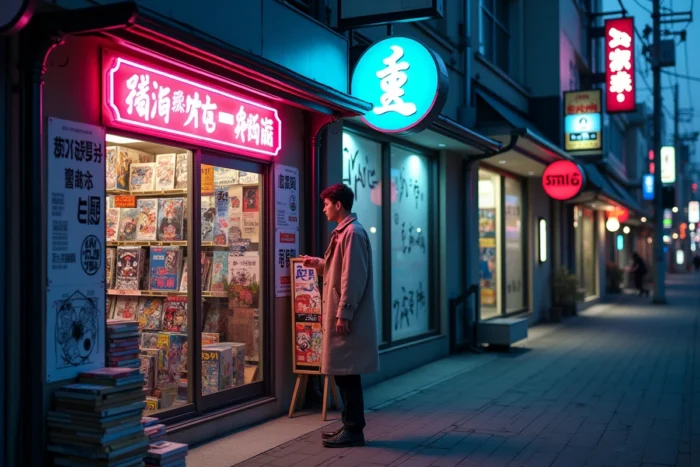
Neon color codes in shonen and seinen mangas: what each hue tells
The neon color in a manga is not merely a decorative choice. It participates in a narrative language where each hue carries a precise emotional weight.
Blue and purple: cold tension and contained power
Saturated cool tones signal a character in retreat, a latent threat, or an unliberated power. In shonen, an antagonist bathed in neon purple indicates to the reader that the fight has not yet peaked. The color functions as a visual stage direction.
Neon red and orange: urgency and tipping point
Neon red appears at moments of narrative rupture. A transformation, a sacrifice, an overflowing anger. Neon red marks the point of no return in a scene. Mangakas use it sparingly to preserve its impact: a double page saturated with red loses its effect if the previous one was also.
Neon green: otherness and raw energy
Less common, neon green signals what escapes the normal order of the narrative. Demons, supernatural powers, mutations. In seinen, it often serves to visually distinguish a parallel universe or an altered consciousness.
This distribution is not rigid, but it constitutes a foundation that readers unconsciously assimilate over the chapters. A character whose halo shifts from blue to red tells a story even before the text confirms it.
From paper manga to AI prompt: how neon remains readable across media
Neon manga now circulates between very different media. A fan artist on a tablet, a dark anime tattoo artist, and an AI image generator user mobilize the same visual references. This portability rests on three pillars.
- The dark background / saturated color contrast: regardless of the medium, neon visually exists only on a black or very dark background. A neon manga tattoo uses a solid black ink to make the fluorescent lines stand out, just like a nighttime manga panel.
- Reflections and wet surfaces: rainy street scenes, puddles reflecting signs, the shining eyes of characters. These elements create a luminous depth that works equally well in print, digital, or on skin.
- The recognizable silhouette: a character illuminated in neon loses its internal details. Its silhouette must therefore be distinctive enough to remain identifiable. Exaggerated hairstyles, marked accessories, and iconic postures of manga take on their functional meaning here.
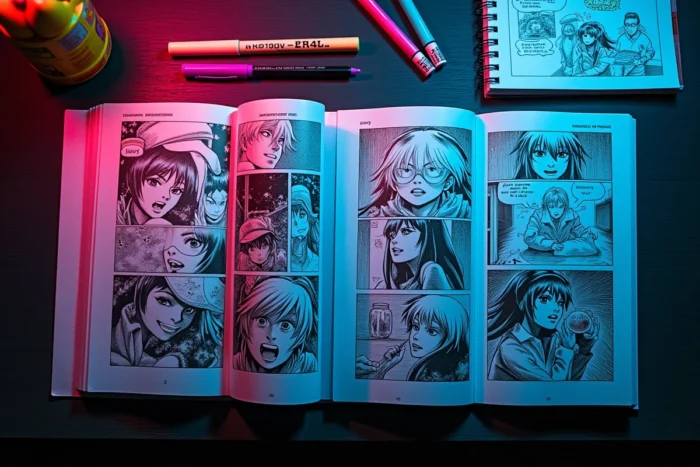
AI image generation prompts now incorporate these three elements as explicit parameters. Recent creation guides recommend combining “neon glow,” “wet street reflection,” and “dark background” to achieve a result consistent with the genre’s codes. The technical vocabulary of manga has become a parameter-setting language.
Manga works where neon structures the narrative and not just the decor
Some works use neon as a narrative element in its own right, not just as a simple visual dressing.
Cyberpunk-type narratives anchor their plots in megacities where artificial light replaces natural light. Neon signals urban density, surveillance, alienation. The absence of neon in a scene – a character in total darkness – then becomes a narrative event.
In mangas with a supernatural focus, neon distinguishes the human world from the demon world. Battles between characters produce neon bursts whose color and intensity reflect the power hierarchy. A reader accustomed to the codes can assess the power dynamics before reading a single dialogue bubble.
Recent shonen sagas push this logic further by associating a specific neon palette with each character. The color becomes a permanent narrative attribute, on par with a character trait or combat technique. Neon then functions as an extension of the narrative, readable even in a reduced format like a webtoon panel or a social media thumbnail.
This ability to condense narrative information into a compact visual code explains why neon manga has migrated so easily to other media. A tattoo takes on a character’s palette, a fanart retains the characteristic contrast of a scene, an AI prompt reproduces the atmosphere of an entire genre in a few keywords. The code remains stable because it relies on conventions shared by a community that practices them daily, from reader to creator.