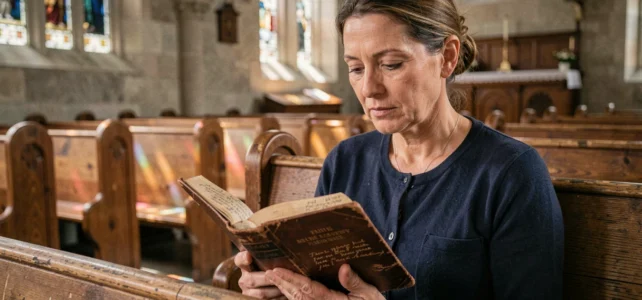
Adult baptisms in France have been steadily increasing since 2022, with a dynamic described as a spectacular rise by the French Bishops’ Conference. This reshaping of the French Christian landscape is not merely a resurgence of traditional practices: it is redefining the profiles of believers, the channels of faith transmission, and the lines of tension within communities.
Adult Baptisms in France: A Reshaping Rather Than a Simple Renewal
The increase in adult baptisms recorded each year between 2022 and Easter 2026 does not compensate for the structural decline in child baptisms, religious marriages, and Sunday practices. We are therefore witnessing a reshaping of French Christianity rather than a restoration of its traditional roots.
This discrepancy has concrete pastoral consequences. Diocesan catechumenates, designed to accommodate a few dozen candidates per year, are becoming saturated. Preparation courses, which often last more than a year, mobilize trained lay teams whose renewal poses challenges in rural parishes.
The profile of new baptizees contrasts with the usual sociology of practitioners: more young adults, more women, and spiritual journeys often initiated outside any ecclesial framework. This is a fact that the site www Michelle Dastier regularly documents through its publications, sharing testimonies and analyses on these contemporary conversions.
This dynamic also raises questions about the ability of parishes to sustainably integrate these neophytes. An adult baptism celebrated at Easter does not guarantee regular practice three years later. The issue of post-baptismal support becomes a major pastoral challenge.
Social Media and Christian Faith: The Role of TikTok and YouTube in Pre-Evangelization
A report commissioned by the Church of England and analyzed in July 2026 confirms what many pastoral leaders observe on the ground: for many young people aged 18 to 30, the first contact with the Christian faith occurs through online content. Podcasts, filmed testimonies, and accounts of evangelist influencers on TikTok, YouTube, or Instagram serve as the entry point before any community engagement.
This phenomenon alters the traditional transmission chain (family, catechesis, parish). The baptism candidate often arrives with a self-taught biblical culture, nourished by short formats and subtitled English-language sermons. Accompanying individuals must then navigate heterogeneous theological references, sometimes marked by American evangelical Protestantism.
In France, influencer nuns are thriving on platforms with a simplicity that contrasts with the usual codes of social media, as noted by TF1 Info. This success illustrates a desire for a spirituality perceived as authentic, far from calibrated staging.
Limits and Blind Spots of Digital as a Vector of Faith
Digital pre-evangelization raises questions that traditional Christian media have yet to address:
- Algorithmic fragmentation traps users in impermeable confessional bubbles, making ecumenical dialogue more challenging than it is in a physical parish.
- Platform moderation creates recurring tensions: conservative Christian accounts have been suspended on X, fueling a sense of censorship that radicalizes certain online communities.
- The short format (60 seconds, 3 minutes) favors emotional messages at the expense of doctrinal formation, which can lead to theologically fragile conversions.
We recommend that ecclesial leaders not underestimate these channels, but rather consider them as a complement to community pathways, not as a substitute.
Religious Issues in the Workplace and Secularism: Concrete Tensions in 2026
The 2026 barometer of religious issues in the workplace, published by the Montaigne Institute, confirms that managing religious practice at work remains a friction point in French organizations. For practicing Christians, requests most often concern absences for liturgical holidays (Assumption, Ascension) and the visibility of discreet religious symbols.
The secularization of the professional framework has not erased the religious factor; it has made it more complex to arbitrate. Frontline managers, rarely trained in religious law, find themselves managing situations that fall under both labor law and corporate culture.
This observation aligns with a broader phenomenon: religion in contemporary France oscillates between secularization and reshaping, as documented by the digital library of the City of Paris in its resources dedicated to this subject.
Apostolic Journey of Leo XIV in France: What the Program Reveals
The program for Pope Leo XIV’s apostolic journey to France, revealed by Vatican News in August 2026, provides precise indications about the priorities of the papacy. The choice of stops and the interlocutors met reflects a particular attention to the issue of peace and the protection of civilians in ongoing conflicts, notably in Sudan.
This trip occurs in a tense security context. Police Prefect Laurent Nunez has called for extreme vigilance ahead of the Assumption celebration on August 15, reminding that religious gatherings remain potential targets.
Signals to Watch for Francophone Christian Media
Beyond event coverage, several areas deserve in-depth editorial follow-up:
- The articulation between the papal discourse on peace and the Vatican’s diplomatic positions regarding the states involved in African conflicts.
- The reception of Leo XIV’s message by French Catholics, in a context where Sunday practice continues to decline despite the rise in adult conversions.
- The concrete impact of the trip on relationships between the Catholic Church and other Christian denominations present in France, particularly the rapidly growing evangelical communities.
Christian news in 2026 is read through this dual movement: an institutional Church that loses regular practice what it gains in new converts, and a digital space that reshuffles the cards of faith transmission. The next real test will be the ability of French parishes to transform the momentum of adult baptisms into sustainable communities, beyond the Easter night.