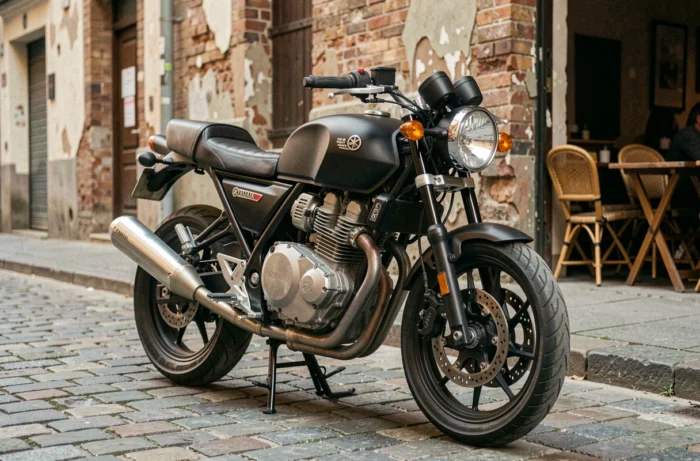
The Yamaha XSR 155 shares its technical base with the MT-15, but the two motorcycles behave differently in everyday use. Engine displacement, ergonomics, road behavior: the available data allows us to measure what this neo-retro model truly brings compared to other models in the 150-160 cm³ segment.
This article reviews the features of the Yamaha XSR 155 through its technical specifications, power discrepancies according to markets, and the most recent user feedback.
Yamaha XSR 155 against the competition: compared technical data
The segment of small neo-retro motorcycles has become denser in recent years. The XSR 155 positions itself with a liquid-cooled single-cylinder engine and electronic fuel injection. To situate this model, a comparative table helps to read the differences.
| Criterion | Yamaha XSR 155 | Yamaha XSR 125 (Euro5+) |
|---|---|---|
| Engine Displacement | 155 cm³ | 125 cm³ |
| Power (Asian market) | About 19 hp | About 15 hp |
| Power (US version 2027) | About 17.2 hp | – |
| Cooling | Liquid | Liquid |
| ABS | Yes (single-channel) | Yes |
| Style | Neo-retro | Neo-retro |
| Main Market | Asia, then the United States (2027) | Europe |
The power gap between the Asian version and the American version deserves attention. Nearly 2 hp separate the two homologations, a difference linked to the emission and noise standards specific to each area. This delta, modest in appearance, is felt in mid-range acceleration, where the single-cylinder engine works the most in urban use.
To learn everything about the Yamaha XSR 155, it should also be considered that the platform shared with the MT-15 provides access to a particularly wide catalog of aftermarket parts and accessories, a concrete advantage for customization.
Variable power according to markets: what homologation changes
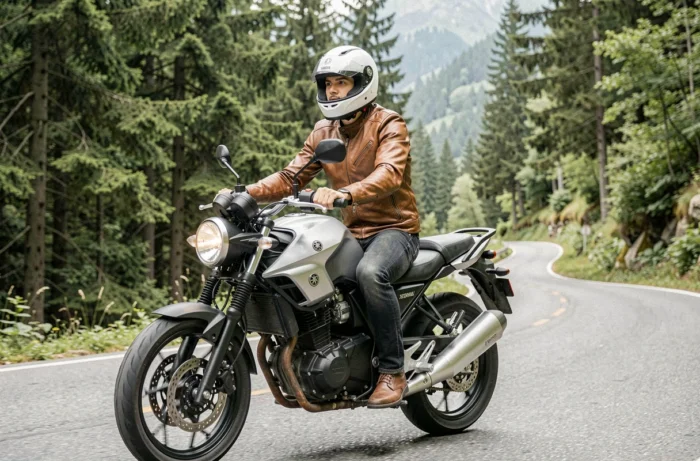
The XSR 155 is not a monolithic model. According to data published by Motorcycle.com in August 2026, the NHTSA homologation for the American market was registered as early as 2026, paving the way for official marketing in 2027. The announced power for this version is around 17.2 hp, compared to about 19 hp in Indonesia.
This variation is not trivial. It reflects different engine mappings, adjusted to meet local emission thresholds. In Southeast Asia, where standards are less restrictive on certain pollutants, the engine can deliver its full power.
Consequences on road behavior
The test conducted in Japan (Webike, June 2026) confirms that the XSR 155 easily reaches 100 km/h on the highway with stability deemed remarkable for its category. The tester highlights maneuverability comparable to that of a 50 cm³ in the city, combined with light motorcycle performance on open roads.
The American version, with its slightly reduced torque, may require a bit more revs to achieve the same level of comfort at stabilized speed. Future owners in the United States will need to take this into account, especially for mixed city-highway use.
Engine, suspension, seat: user feedback after several thousand kilometers
Technical sheets do not tell the whole story. Feedback published in 2026 by owners who have accumulated significant mileage provides a more nuanced perspective than press tests lasting a few hours.
An engine that garners unanimous praise
The single-cylinder engine is considered extremely smooth and reliable over the long term. Several owners, particularly on the Team-BHP forum (August 2026), describe engine performance among the best in the 150-160 cm³ segment. The revs build linearly, without notable torque dips, and vibrations remain contained even at high revs.
- Operating smoothness above average for the segment, including on long trips
- Mechanical reliability confirmed after several thousand kilometers of daily use
- Precise fuel injection that facilitates city riding (no jerks at low revs)
Rear suspension and seat: the two recurring weak points
The observation is consistently echoed in user feedback: the rear suspension is noticeably firm. On degraded roads or urban cobblestones, it transmits irregularities to the rider in a marked way. This flaw can be tiring on daily commutes, especially when riding two-up.
The seat, on the other hand, is frequently described as too thin for distances exceeding one hour of continuous riding. This point does not appear in Yamaha’s official presentations, but it affects the actual comfort of use.
- Rear suspension could be improved on damaged roads (replacement with an aftermarket shock absorber frequently recommended)
- Original seat too firm for long trips, comfort seat option to consider
- Single-channel ABS braking is effective and reassuring, even on wet surfaces
XSR 155 and the European market: the link with the XSR 125
The XSR 155 is not marketed in Europe, where A1 license regulations limit engine displacement to 125 cm³. Yamaha offers the XSR 125, updated to Euro5+ for the 2025 model year with new colors. Both models share an identical neo-retro philosophy and a common visual DNA.
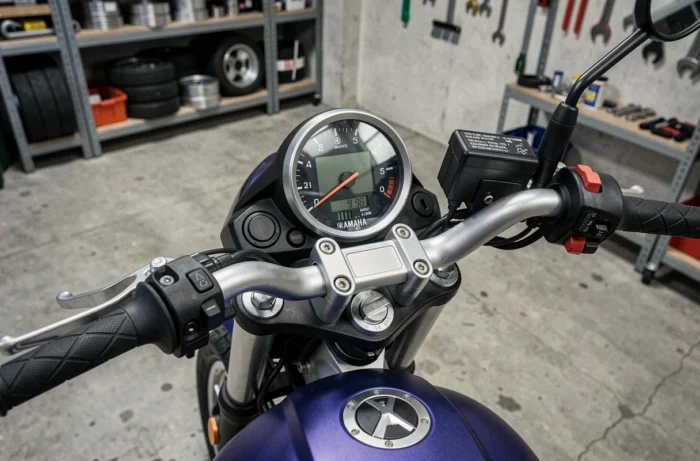
The XSR 125 adopts the aesthetic codes of the XSR range (bulging tank, round instrumentation, clean lines) while adapting to European constraints. The difference in engine displacement creates a notable performance gap: about 4 hp separate the two versions, which translates into more pronounced acceleration and better comfort on fast roads for the 155.
The confirmed arrival of the XSR 155 in the United States for 2027 raises the question of a possible regulatory evolution or a specific version for the European market. So far, there has been no official announcement from Yamaha in this regard.
The Yamaha XSR 155 remains a motorcycle designed for markets where small-displacement bikes constitute the core of the vehicle fleet. Its engine is its strongest argument, while the rear suspension and seat represent the two areas to prioritize for daily use. The recent American homologation could change the game for European riders, but nothing confirms a launch in Europe at this stage.