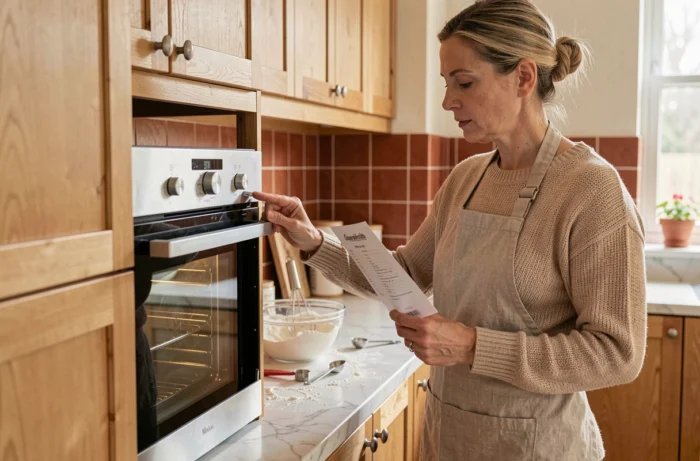
The conversion formula between thermostat and degrees Celsius is based on a fixed coefficient: one thermostat level equals 30 °C. Thermostat 5 gives 150 °C, thermostat 6 gives 180 °C. This rule covers almost all French cooking recipes, but it hides a problem that few amateur cooks suspect: the actual temperature inside the oven does not always match the displayed temperature.
Actual Temperature Variation in a Home Oven
Home ovens have a normal variation of plus or minus 10 to 15 °C around the set temperature. A thermostat set to 180 °C can therefore heat to 165 °C or 195 °C depending on the appliance, its age, and maintenance.
This discrepancy explains why two cooks following the same recipe can achieve different results. A marble cake baked at a real 170 °C instead of 180 °C will have a less cooked center and a paler crust. Conversely, an oven that overheats by 15 °C dries out white meats.
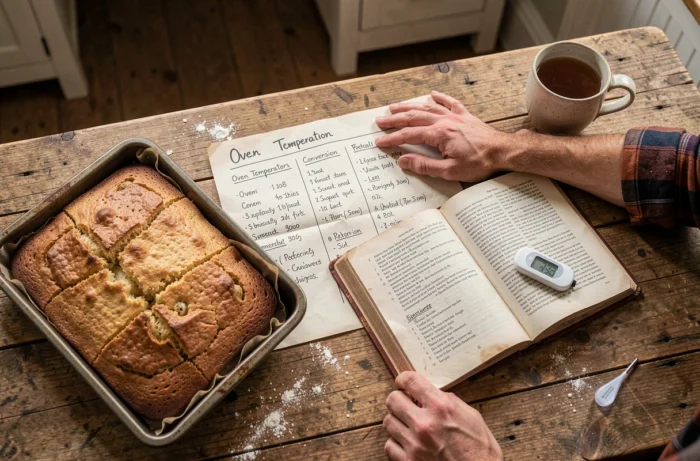
To know the actual temperature of your oven, an independent oven thermometer (placed in the center of the rack) remains the most reliable method. This accessory costs a few euros and allows you to adjust the thermostat with knowledge rather than relying on an approximate display.
Mastering the conversion from 150 to 180 degrees in thermostat is therefore not enough: you must also check that your appliance accurately reflects the setting.
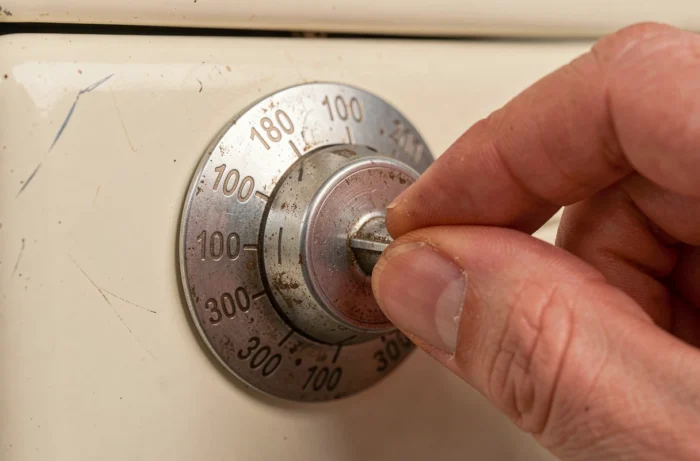
Conversion Table for Thermostat and Degrees Between 150 and 180 °C
The range of 150-180 °C corresponds to thermostats 5 and 6. In between, some recipes call for 160 °C or 170 °C, which do not fall on any round thermostat number.
| Temperature (°C) | Thermostat | Heat Category |
|---|---|---|
| 150 | 5 | Medium oven |
| 160 | Between 5 and 6 | Medium oven |
| 170 | Between 5 and 6 | Medium to hot oven |
| 180 | 6 | Hot oven |
For a recipe at 160 °C, set to thermostat 5 and let the oven preheat for a few more minutes. For 170 °C, position the knob slightly above 5, halfway towards 6. Ovens with graduated knobs tolerate these intermediate settings without difficulty.
Recent digital ovens allow you to set the temperature to the exact degree, making conversion unnecessary. If your oven displays degrees Celsius directly, always prioritize this indication over the thermostat number.
Common Recipes Between Thermostat 5 and Thermostat 6
The range of 150-180 °C covers a wide variety of preparations. Understanding which thermostat corresponds to which type of dish helps avoid the most common cooking errors.
Thermostat 5 (150 °C): Slow Cooking and Delicate Pastries
At 150 °C, the heat remains moderate. This is the reference temperature for preparations that require gradual drying or slow setting:
- Meringues and macarons, which must dry without coloring, bake at thermostat 5 or slightly below
- Gingerbreads and large light cakes benefit from slow cooking to maintain an even softness
- Set creams (flans, caramel creams) require moderate heat to avoid boiling or curdling
Thermostat 6 (180 °C): Roasts, Gratin Dishes, and Classic Pastries
Thermostat 6 is the most commonly used setting in home cooking. The majority of cake, tart, and roasted dish recipes converge towards this temperature:
- Veal and pork roasts develop a golden crust while remaining tender inside
- Dauphinois gratins and lasagna cook at 180 °C to achieve a grilled surface without drying out the inside
- Classic pound cakes, cakes, and genoise are baked at thermostat 6 for about thirty minutes depending on their size
When a recipe indicates “medium oven,” it generally refers to this range of 150-180 °C. A “hot oven” starts at 180 °C and goes up to 220 °C, which corresponds to thermostats 6 to 7.
Convection Heat and Oven Temperature Conversion
Convection heat changes the game. A fan distributes hot air evenly throughout the oven cavity, which speeds up cooking and makes it more uniform.
In practice, a convection oven cooks like a traditional oven set 10 to 20 °C higher. If a recipe calls for 180 °C in traditional mode (thermostat 6), reduce to 160-170 °C in convection mode. This corresponds to a thermostat between 5 and 6.
This adjustment is rarely mentioned in classic French recipes, which were designed for natural convection ovens. Recent pastry books are beginning to specify “180 °C static heat” or “160 °C convection heat,” but most online recipes omit this distinction.
Ignoring the cooking mode distorts the thermostat-degree conversion. A thermostat 6 in convection mode produces a result comparable to a thermostat 7 in static mode, which is about 200 °C actual.
Preheating and Rack Position: Two Often Overlooked Variables
The thermostat-degree conversion assumes that the oven has reached its set temperature before baking. A preheating time of 10 to 15 minutes is necessary to stabilize the temperature inside. Baking in a cold oven means cooking at a lower temperature during the first few minutes, which affects the rising of doughs and the searing of meats.
The position of the rack also plays a role. The lower part of the oven concentrates more radiant heat (bottom element), while the upper part exposes dishes to the grill. For even cooking at 180 °C, the middle rack remains the default choice. Pizzas and tarts benefit from being lowered one notch to achieve a crispy bottom without burning the top.
Converting 150 or 180 °C to thermostat 5 or 6 poses no arithmetic difficulty. The real variable is the behavior of each oven. An independent thermometer, the right cooking mode, and proper preheating transform a theoretical conversion into controlled actual temperature.