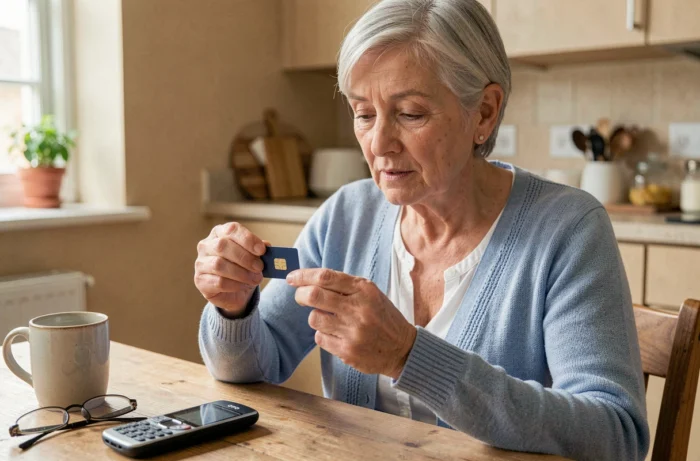
Doro phones occupy a unique place in the mobile phone market in France. Designed to simplify daily use, they meet the expectations of a senior audience that prioritizes readability, robustness, and accessibility of calling functions. The choice of a SIM card for these devices may seem trivial, but several technical constraints, related to both the network and the phone itself, can turn a simple purchase into a source of frustration.
Shutdown of 2G and 3G: what changes concretely for Doro
The issue goes beyond just the format of the SIM card. In France, the gradual shutdown of 2G is scheduled between 2026 and 2029, followed by that of 3G starting in 2028 according to operators. Arcep confirms that the transition to 4G and 5G networks is accelerating, with distinct timelines from one operator to another.
For a Doro phone user, the consequence is direct: a recent SIM card inserted into a model compatible only with 2G or 3G does not guarantee lasting service. The phone may work today and lose its calling capability in the following months, without warning.
Subscribers of virtual operators using a host network in roaming are also affected by these gradual shutdowns. Before choosing a SIM card suitable for Doro phones, it is essential to first check that the model supports 4G.
VoLTE on Doro phone: the trap of the 4G label
A Doro labeled “4G” does not automatically solve the problem. Some models use 4G for internet browsing but revert to 2G or 3G when making a voice call. This switch remains invisible to the user.
When the 2G or 3G network disappears, a phone without VoLTE loses its ability to make and receive calls, even if it shows a 4G signal. The “4G” label on the product sheet is not enough: it is necessary to ensure that the model supports VoLTE (Voice over LTE), a protocol that allows calls to be made directly over the 4G network.
How to check the VoLTE compatibility of a Doro
Buying guides rarely mention this constraint. The most reliable test remains empirical: insert the SIM card, make a call, and observe if the 4G symbol remains displayed during the conversation. If it disappears or switches to a 2G/3G indicator, the phone does not support VoLTE on this network.
Some operators publish lists of VoLTE-compatible devices on their support site. Checking for the exact Doro model on this list before purchasing the SIM avoids an unpleasant surprise.
Senior mobile plan and Doro SIM card: the criteria that really matter
Once network compatibility is confirmed, the choice of plan deserves special attention. The needs of a Doro phone user differ significantly from those of a typical smartphone user.
- Unlimited calls and texts without commitment: the majority of usage on Doro focuses on voice calls and SMS. A no-commitment plan with unlimited calls covers the essential daily need.
- Reduced mobile data volume: Doro phones, even smartphone models, consume little data. A few gigabytes are sufficient for updates and light internet usage.
- Host network compatible with 4G/VoLTE: the cheapest plan loses all interest if the underlying operator does not support VoLTE on the Doro model used. This point takes precedence over the monthly price.
- Accessible phone support: a customer service reachable by phone, and not only by chat or app, remains a determining criterion for this audience.
Plans specifically labeled “senior” do not always offer a technical advantage over standard plans. The difference often lies in the support for activation and the simplification of the bill.
SIM card format according to Doro model: micro, nano, or triple cut
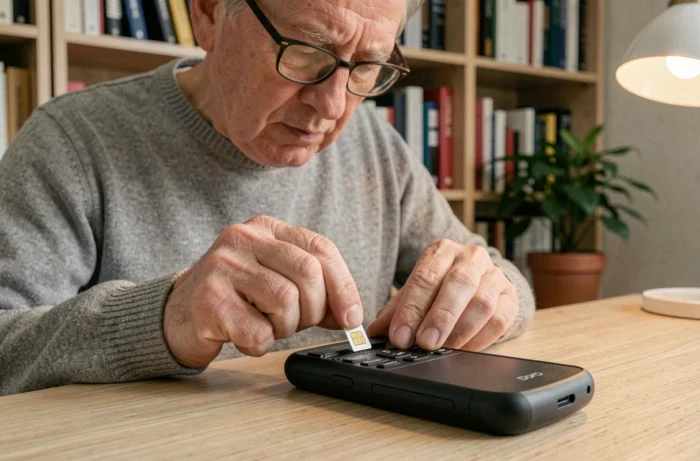
The physical format of the SIM varies according to the generations of Doro phones. The oldest flip models accept a standard SIM card or micro-SIM. Recent Doro smartphones, like the Doro 8100, use a nano-SIM.
Triple-cut SIM cards, provided by most operators, theoretically adapt to all formats. In practice, incompatibilities persist depending on the software versions of the phone, even when the card size is correct. Visual voicemail or access to mobile data may not configure automatically.
Activation and setup on a Doro
Inserting the SIM into a Doro follows a standard procedure: turn off the phone, remove the back cover and battery on flip models, then slide the card into its slot. On Doro smartphones, a side drawer accessible with an ejector replaces this mechanism.
After insertion, the phone usually asks for the PIN code. If network detection does not occur automatically, a restart is sufficient in most cases. For internet settings (APN), some operators send the configuration via SMS upon the first connection. Others require manual entry in the network settings, a step that may need assistance from a relative.
The choice of a SIM card for a Doro phone relies less on the format or the price of the plan than on the actual network compatibility of the model. With the scheduled end of 2G and 3G networks in France, checking support for 4G and VoLTE before any purchase becomes the most useful precaution to ensure sustainable daily use.