How did a small novelty counter from the late 19th century become one of the most well-known department store groups in the world? The history of Galeries Lafayette is measured through its expansions, strategic refocusing, and the decisions of its successive owners. Three periods structure this trajectory: the Alsatian foundation, the golden age of the Parisian department store, and the contemporary restructuring around the flagship store on Haussmann.
Timeline of Galeries Lafayette: key dates and strategic turning points
| Period | Event | Impact |
|---|---|---|
| 1893 | Opening of a novelty counter by Théophile Bader and Alphonse Kahn, rue La Fayette | Birth of the brand, initially small surface area |
| 1896 | Purchase of the building at 1 rue La Fayette | First expansion, transition from a counter to a structured store |
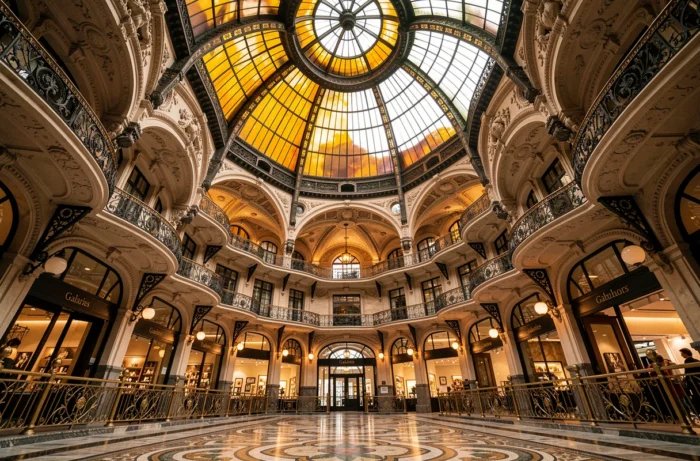
| Early 20th century | Construction of the neo-Byzantine dome and Art Nouveau balconies | Creation of a Parisian architectural monument |
| 1950s-1980s | Expansion in the provinces and internationally | Network of department stores in several French cities |
| 2018-2021 | Sale of regional stores to Michel Ohayon | Refocusing on the Haussmann flagship, struggling affiliated network |
| February 2023 | Placement under safeguard procedure of stores linked to Ohayon | Crises contained to the divested perimeter, not the central group |
| Horizon 2030 | Major investment plan centered on Haussmann | Strategy to strengthen the flagship store |
This table highlights a recurring pattern: each phase of expansion has been followed by a refocusing on Paris. The brand has never sustainably consolidated a homogeneous provincial network. To delve deeper into the history and ownership of Galeries Lafayette, the journey of the founders sheds light on the governance choices that followed.
Théophile Bader and the Moulin family: family governance of Galeries Lafayette
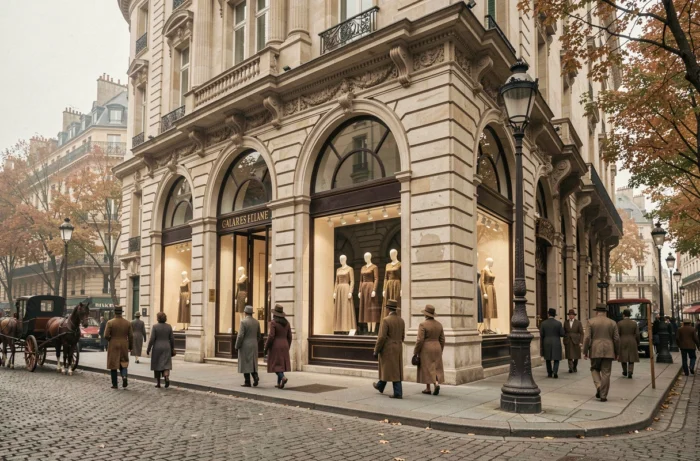
Théophile Bader led the brand for nearly half a century. Arriving from Alsace with his cousin Alphonse Kahn, he oversaw the transformation of a small novelty store into a luxury department store located in the heart of boulevard Haussmann, near the Opéra Garnier.
The very name of the brand, originally “Aux Galeries Lafayette,” simply comes from the address of the first counter on rue La Fayette. The double “t” in the logo conceals the silhouette of a stylized Eiffel Tower, visually anchoring the brand in its Parisian identity.
After World War II, control of the group gradually passed to the Moulin family, heirs of Bader. This family still owns the group through the holding company Motier. The family governance distinguishes Galeries Lafayette from most of their competitors in the department store sector in France.
A model of heritage transmission
The family continuity has allowed for long-term decisions that are difficult to envision in a publicly traded structure. The investment plan announced for 2030, focused on the renovation of the Haussmann store, illustrates this ability to commit resources over several years without quarterly shareholder pressure.
On the other hand, this same governance has sometimes slowed down restructuring decisions for the provincial network, where closures and divestitures have stretched over several years.
Provincial network and divestitures: the limits of the multi-city model
Expansion in the provinces has long been a pillar of the group. Stores bearing the Galeries Lafayette name have opened in several major cities in France, from Marseille to Strasbourg.
The sale of 22 stores to Financière Immobilière Bordelaise in 2018 marked a turning point. Eleven more followed in 2021. These stores, entrusted to structures linked to Michel Ohayon, faced financial difficulties distinct from those of the central group.
- In February 2023, 26 stores in the Ohayon perimeter were placed under safeguard procedure, affecting employment in several provincial cities
- In Marseille, the closure of the store led the city to consider purchasing the premises, a process described as more complex than expected by local elected officials
- In other regional metropolises, permanent closures have highlighted the economic limits of maintaining department stores in declining city centers
The group opted for a largely affiliated model rather than a fully controlled network. This distinction is crucial: the difficulties of the divested stores do not reflect the financial health of the central group.
Galeries Lafayette Haussmann: flagship and reinvestment strategy
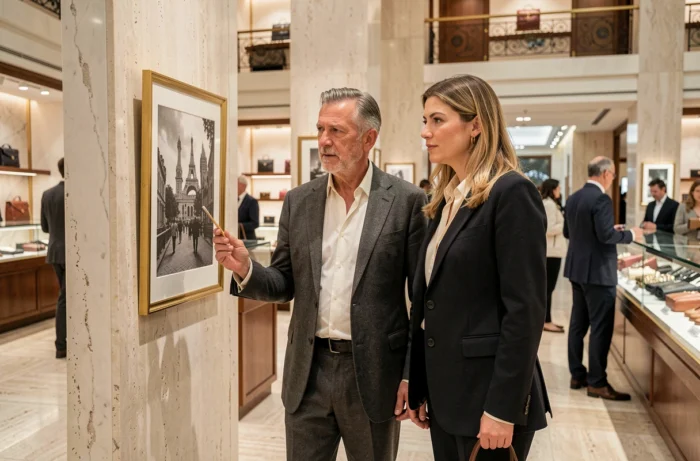
The store on boulevard Haussmann remains the heart of the operation. Its neo-Byzantine dome, designed in the early 20th century, attracts a considerable number of visitors each year, both international tourists and Parisians. The building serves as both a commercial space and a monument of Parisian architectural heritage.
An investment plan aimed at 2030
The group has embarked on a major renovation program centered on the Haussmann site. This decision confirms a strategy of strengthening the flagship store rather than reviving geographical expansion. The model now relies on the power of a unique location, complemented by lighter formats (affiliated, pop-up) in other cities.
This approach contrasts with the previous period, where the brand sought to replicate the department store format in urban contexts very different from Paris. The refocusing on Haussmann reflects a realization: the profitability of the department store largely depends on tourist flows that only the capital generates at this scale.
Galeries Lafayette and artistic creation: the cultural role of the department store
Beyond fashion and luxury retail, Galeries Lafayette has developed a cultural activity through the Galerie des Galeries, an exhibition space dedicated to contemporary art. This positioning extends an old tradition: as early as the beginning of the 20th century, the Haussmann store integrated decorative elements related to the arts nouveau.
The foundation of the group also supports initiatives in the field of creation. This cultural aspect helps differentiate the brand from online sales platforms by offering an experience that digital commerce cannot reproduce.
The history of Galeries Lafayette ultimately reads as one of gradual refocusing. From a fragmented network across France, the group has returned to what initially made it strong: a location, an address, a store on boulevard Haussmann. The 2030 plan confirms this choice. The open question concerns the future of the former provincial stores, some of which are still seeking a second life.