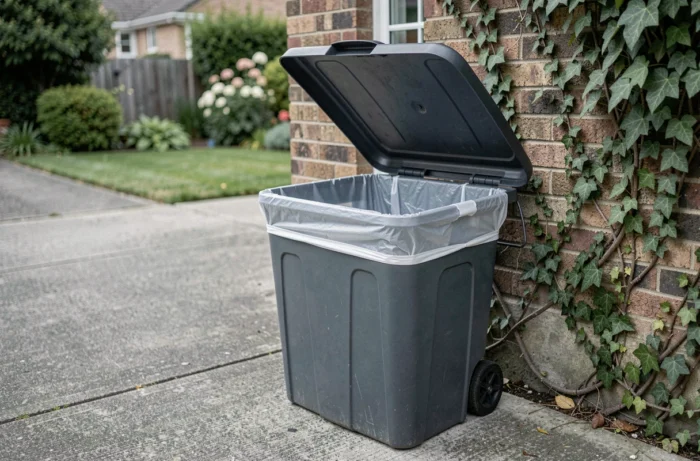
Maggots in a trash can are not an inevitable summer fate. Their appearance results from a specific sequence: flies detect decomposing organic matter, lay eggs that hatch within hours when the temperature is favorable. Understanding this mechanism allows for targeting the right actions, but also dispelling several misconceptions that circulate abundantly online.
Fly Breeding Cycle: What Really Triggers Infestation
A housefly does not lay eggs randomly. It seeks a humid, warm environment rich in decomposing proteins. The residual trash bin ticks all these boxes as soon as it contains meat, fish, or dairy leftovers left unprotected for more than a few hours.
The speed of the cycle often surprises. Between laying eggs and the appearance of visible larvae, less than a day can pass in the height of summer. Closing the lid is not enough if the seal is not real: flies exploit the slightest gap to access the waste.
To better understand maggots in the trash according to Habitat Vision, it is necessary to distinguish what constitutes a true triggering factor and what is a myth repeated from article to article.
Maggots and Trash: Three Persistent Myths Scrutinized
The first myth concerns white vinegar. Presented everywhere as a miracle repellent, it actually has only a very temporary effect. Its acidic smell briefly masks the odors of decomposition, but it dissipates within a few hours. White vinegar does not kill already laid eggs. It can be used for cleaning after emptying, but not as a reliable preventive barrier.
The second myth relates to essential oils of mint or eucalyptus. In an outdoor trash can exposed to the sun, the concentration of active ingredients drops quickly. A few drops on a lid do not create a lasting exclusion zone.
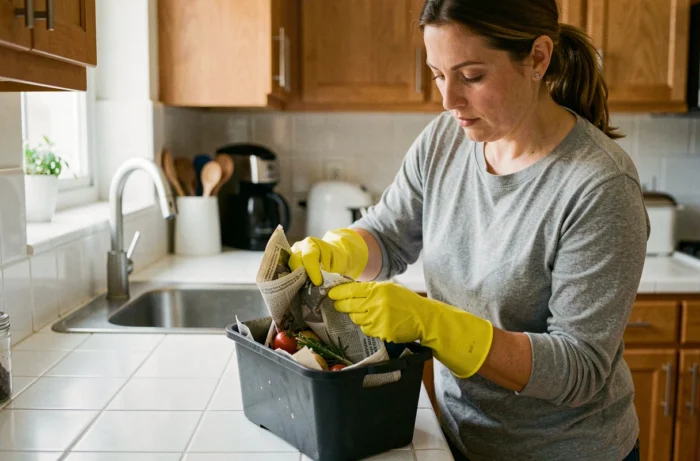
The third myth is more subtle: the idea that a well-sealed trash bag prevents any infestation. A standard bag has micro-perforations, especially if it contains fish bones or scraps. Flies detect organic matter through a thin punctured bag, and laying can occur on the bag itself, in immediate proximity to the perforation.
Source Separation of Biowaste: The Most Underestimated Preventive Lever
Since January 1, 2024, French municipalities must offer residents a solution to separate their food waste. Individual composting, shared composting, separate collection, or voluntary drop-off points: the systems vary from one area to another.
This obligation changes the game regarding the issue of maggots. By removing from the gray bin the materials that primarily attract flies (peelings, meal leftovers, shells), we eliminate the cause rather than treating the symptom.
Field feedback varies on this point: some municipalities require bulk deposit or in a kraft paper bag, while others provide a bio-bin. Some areas refuse plastic bags, including those marketed as compostable. There is no single national rule on the container or the frequency of deposit. Checking local guidelines remains the first concrete step.
Short-term storage in a dedicated bio-bin, with regular emptying into the drop-off point or composter, reduces the time during which leftovers are accessible to flies. This simple action has more impact than a weekly cleaning with bleach.
Cleaning the Trash Can and Physical Barriers: What Really Works
Cleaning remains useful, but its effectiveness depends on the timing and method. Washing the trash can after each collection with hot water (not lukewarm, not cold) removes organic residues stuck to the walls, where flies primarily lay eggs.
- Rinse the bottom and inner walls with a high-pressure jet, focusing on the grooves of the lid where decomposition juices accumulate
- Let the bin dry open in the sun before replacing a bag, as residual moisture attracts flies just as much as food itself
- Double the bottom of the bin with newspaper or corrugated cardboard, which absorbs liquids and is replaced at each collection
The most effective physical barrier remains a tightly sealed lid. Bins with loose hinges or domed lids leave enough space for a fly to enter. If the bin provided by the municipality does not close properly, a simple rubber band from a bicycle inner tube around the lid improves the seal.
Collection Frequency and Storage: The Blind Spot of Online Advice
Most articles on the subject focus on products to apply in the trash can. Few mention the impact of collection frequency. A collection every two weeks in summer is enough to create the conditions for an infestation, even with a clean bin.
When the collection schedule becomes less frequent (holidays, summer periods), two precautions reduce the risk:
- Freeze meat and fish leftovers until the collection day, rather than throwing them in the trash several days before pickup
- Place the bin in the shade and not in direct sunlight, as heat accelerates decomposition and shortens the laying cycle to just a few hours
- Use a thick trash bag (reinforced thickness, often identifiable by touch), which is more resistant to punctures from sharp waste
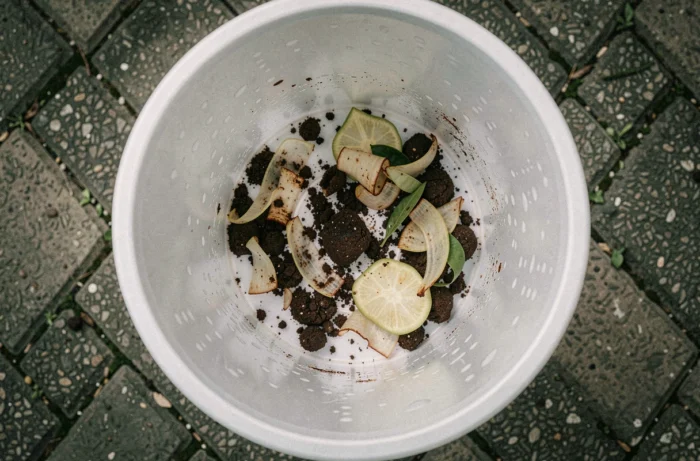
Storing biowaste in a separate closed container, emptied regularly, remains the most effective upstream action. The residual trash can should only contain non-organic waste or dry materials that do not attract flies.
No product, natural or chemical, can replace the removal of the food source. Maggots do not colonize a trash can by chance: they respond to a specific chemical signal. Eliminating this signal upstream spares most of the curative treatments offered online.