
Meeting a local community, staying with locals, participating in a development project on-site: solidarity tourism promises a travel experience that is radically different from the classic stay. This promise faces concrete difficulties that travelers and operators often underestimate. Understanding these challenges allows for more responsible travel without giving up the sought-after positive impact.
Risk management and safety: the forgotten angle of solidarity tourism
The safety of travelers is an integral part of sustainable and operational tourism, even if solidarity programs often relegate it to the background behind social impact.
A solidarity stay often takes place in rural areas, sometimes far from health infrastructure. The state of the roads, access to emergency care, travel restrictions in certain regions: these are parameters that official travel advisories regularly remind travelers of. Ignoring these aspects puts participants and host communities at risk.
A viable solidarity project integrates risk management from its conception. This means planning for appropriate medical coverage, checking local transport conditions, and establishing an evacuation protocol. Without this foundation, the project remains fragile, regardless of the quality of its intentions.
Before committing, it is useful to learn about the challenges of solidarity tourism to measure the gap between the stated ideal and the constraints on the ground.
Greenwashing and labels: how to verify a destination’s commitment
The word “solidarity” on a brochure guarantees nothing. This is a well-documented problem: many tourism offers use responsible vocabulary without changing their practices. This phenomenon has a simple name: greenwashing.
Why is this issue gaining traction now? Because European regulatory developments are increasingly framing environmental claims. Labels and certifications for sustainable tourism now serve as regulatory frameworks, not just marketing showcases.
For a traveler, the challenge is to distinguish a serious label from a decorative sticker. A few guidelines help clarify:
- A credible label is based on a public specification, verifiable online, with specific criteria regarding the environment, income distribution, and respect for local communities.
- The certification is issued by an independent body from the tour operator, with regular audits on the ground.
- Feedback from host communities is taken into account in the renewal of the label, not just traveler satisfaction.
An operator who refuses to communicate their specifications or displays a label without a verifiable reference sends a warning signal. Demanding transparency remains the best filter against greenwashing.
Real economic impact on local communities
Solidarity tourism promises that the money from travel directly benefits local populations. In practice, the chain of intermediaries often absorbs a majority share of the revenue. Incoming agencies, booking platforms, transporters: each link takes its margin.
A well-designed community tourism project works differently. Revenues are redistributed among community members or invested in collective projects (school, dispensary, biodiversity preservation). This redistribution does not happen on its own.
Without clear local governance, economic benefits remain concentrated among a few individuals. Projects that last are those where the community itself decides on the allocation of resources, with accounting accessible to all members.
Solidarity tourism, as a form of alternative tourism, places people and encounters at the heart of the journey, in a logic of territorial development. This approach implies that the host community actively participates in the development of the tourism project, not just its execution.
Regenerative tourism: going beyond the compensation logic
Sustainable tourism aims to limit damage. Regenerative tourism goes further: it seeks to leave the destination in better condition than before the travelers’ visit. It is a logical extension of solidarity tourism, but it requires a change in perspective.
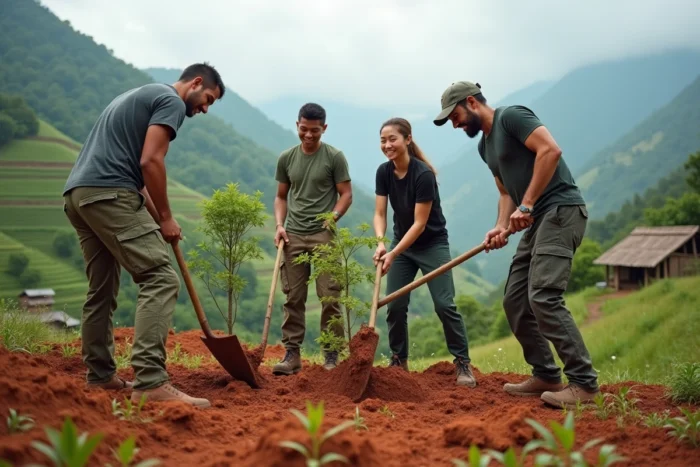
Specifically, a regenerative trip may include restoring a degraded ecosystem, replanting local species, or supporting nature preservation initiatives led by residents. The difference with classic solidarity tourism lies in the goal: not just to reduce negative impact, but to generate a measurable positive effect.
This model remains minority, but it is gaining ground. It poses a useful question for any traveler: does my stay leave something sustainable behind, or is it limited to a personal experience?
Concrete solutions for a functioning solidarity trip
Going on a solidarity trip without preparation amounts to financing a project whose results and limitations are unknown. A few practices can help reduce this risk.
- Check that the operator publishes an annual report on local impacts: number of jobs created, projects funded, share of revenue redistributed to communities.
- Favor stays co-constructed with locals, where the community participated in defining the tourism offer and not just in hosting.
- Choose destinations where tourism development remains proportionate to local capacities, to avoid resource saturation (water, energy, space).
- Inform yourself about safety conditions and health infrastructure before departure, by consulting official travel advisories.
Solidarity tourism works when the traveler agrees to adapt to the territory, and not the other way around. This sometimes implies lesser comfort, flexible schedules, and an immersion that challenges habits.
Relocating tourist flows to closer destinations also opens up possibilities. Several regions in Southern Europe are experiencing strong tourism growth, demonstrating that the solidarity experience does not necessarily require a long-haul flight. A community tourism project in a European rural area can offer the same type of encounter and local impact as a stay on the other side of the world.
Solidarity tourism is not just about choosing a destination. Checking the operator’s practices, respecting host communities, and evaluating the concrete traces left on the territory: these three steps determine the real quality of a stay.