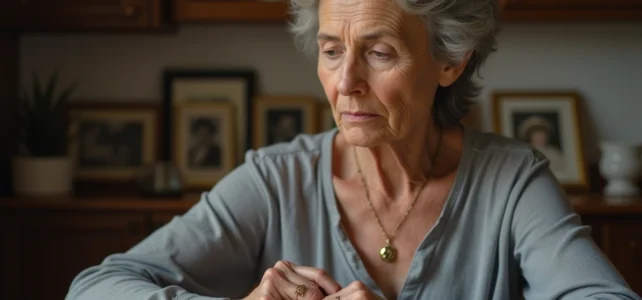
What to do with a wedding ring, a signet ring, or a pendant recovered after a death? The question goes beyond the emotional realm. It involves material dimensions (condition of the jewelry, metal, stones), symbolic aspects (connection to the deceased, family traditions), and practical considerations (adaptation to daily life, maintenance). This article examines these different facets to shed light on a choice that many families face without clear guidelines.
Inherited jewelry, memory jewelry, mourning jewelry: three distinct categories
The terms often get mixed up in conversations and forums. Clarifying the categories helps better understand what one wears and why.
| Type of jewelry | Origin | Main material | Primary function |
|---|---|---|---|
| Inherited jewelry | Passed down after death (wedding ring, ring, brooch) | Gold, silver, period stones | Family continuity, heritage value |
| Memory jewelry | Created from memory materials (hair, dried flowers, ashes) | Resin, glass, contemporary metal | Support for daily mourning |
| Historical mourning jewelry | Worn according to the conventions of a time (jet, onyx, black enamel) | Jet, Berlin iron, braided hair | Publicly signify mourning |
Inherited jewelry is the most common case. It comes into the wearer’s life without having been designed for this purpose. In contrast, memory jewelry is commissioned or intentionally made, sometimes months after the death. Several creators today incorporate dried flowers, hair, or ashes into custom pieces, expanding the scope far beyond a simple ring retrieved from a drawer.
The decision to wear the jewelry of a deceased person thus falls within a broad spectrum, from the spontaneous act (slipping on the wedding band of the deceased spouse) to a thoughtful artisanal approach.

Wearing jewelry from the deceased: what the material imposes before the symbol
Before any question of meaning, an old piece of jewelry poses physical constraints that many underestimate.
Condition of the metal and stones
A piece of jewelry worn for decades often shows significant wear: thinned prongs on a set ring, weakened clasp on a necklace, partially worn gold plating. Having the structural condition evaluated by a jeweler before wearing the piece daily prevents the loss of stones or breakage.
Old alloys differ from current standards. Gold richer in copper can cause skin reactions in some people. A wear test over a few days can help identify any potential incompatibility.
Size and adaptation
A wedding ring that does not fit the wearer’s finger size cannot be worn comfortably as a ring. Three options often arise:
- Have the ring resized by a craftsman, which slightly alters the original piece but makes it wearable daily
- Hang it on a chain to wear as a pendant, a solution that keeps the jewelry intact
- Keep it in a box and create a distinct memory jewelry piece if transforming the original seems too emotionally intrusive
Each option has a cost and an impact on the integrity of the piece. The choice depends on the relationship between sentimental value and daily use.
Meaning of wearing according to cultural and family context
The act of wearing jewelry from a deceased loved one is interpreted differently everywhere. In some families, passing down the wedding band from the father or mother to the first child is a tacit ritual. In others, touching the belongings of the deceased remains delicate for months or even years.
Historical mourning jewelry adhered to strict codes. In the 19th century, black jet and braided hair brooches publicly signaled the mourning period. These conventions have largely disappeared. Today, wearing inherited jewelry is a personal choice, without visible social obligation.
This freedom can also create tensions within families. Who inherits the ring? Should it be offered to all children? The question of distributing jewelry after a death regularly generates conflicts, especially when no will specifies the deceased’s wishes.
The jewelry as a support for mourning
Recurring testimonies describe the worn jewelry as a concrete object of support for mourning, not just a passive memory. The physical contact with the material (turning a ring, touching a pendant) acts as an anchoring gesture during difficult moments.
This role as daily support explains why some people wear the jewelry continuously during the first months, then intermittently afterward. The connection with the deceased does not diminish, but the need for physical contact evolves over time.
Maintenance of old jewelry: common mistakes to avoid
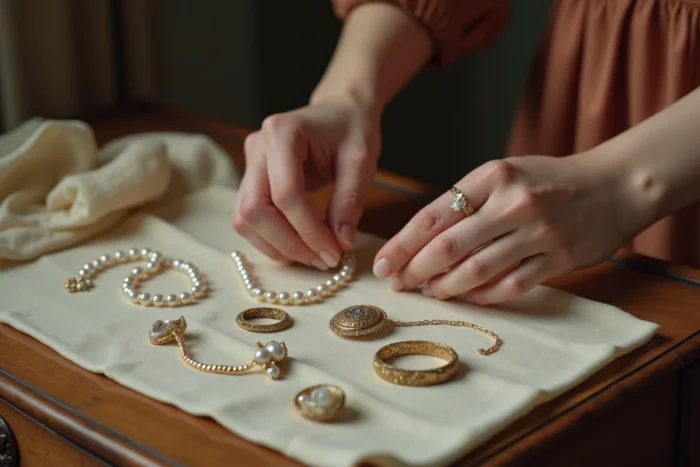
Inherited jewelry requires maintenance suited to its age and materials. General cleaning products for modern jewelry can damage old pieces.
- Pore stones (turquoise, opal, pearl) cannot withstand ultrasonic baths or aggressive chemical solutions
- Jet, a typical material for 19th-century mourning jewelry, scratches easily and can only be cleaned with a soft damp cloth
- Old soldering, often done with alloys different from current standards, can give way under the heat of a poorly calibrated professional cleaning bath
Gentle and regular cleaning preserves better than annual stripping. A quick wipe with a microfiber cloth after each wear is sufficient in most cases.
For pieces of heritage value, a jeweler specialized in the restoration of old jewelry remains the reference. The cost of this expertise is justified by the preservation of an irreplaceable object.
The jewelry of a deceased loved one holds a unique place among everyday objects. Its material ages, its meaning transforms over the years, and the way it is worn says something about the bond each person maintains with their dead. The only mistake would be to let it deteriorate in a drawer without taking the time to assess what it can still offer, whether worn or passed on.