
Applying a vegetable oil to the face means depositing a fatty substance whose composition is similar to the lipids naturally present in the skin. Vegetable oils for healthy skin do not work like a traditional cream: they act on the surface lipid layer, which retains water and filters external aggressions.
Fatty acids and skin barrier: what vegetable oils really bring to the skin
The skin produces sebum to maintain its hydrolipidic film. This film, composed of lipids and water, protects the epidermis from dehydration and irritants. When it becomes depleted (cold, repeated cleansing, aging), the skin feels tight, turns red, or peels.
Cosmetic vegetable oils contain fatty acids (omega 3, omega 6, omega 9) whose molecular structure is compatible with that of skin lipids. Specifically, a suitable vegetable oil strengthens the skin barrier without overloading it. Jojoba oil, for example, has a composition similar to human sebum. It easily integrates into the surface film.
Other oils, rich in linoleic acid (omega 6), contribute to the restoration of a damaged barrier. This is the case with hemp oil, borage oil, or safflower oil. Those rich in alpha-linolenic acid (omega 3) have a more anti-inflammatory profile, useful for reactive skin.
Specialized brands like Vea offer formulations based on vegetable oils designed to restore and protect this barrier daily, focusing on the simplicity of the compositions.
Vegetable oils and anti-aging: real but limited effectiveness
You may have noticed that after a few days of applying an oil to your face, the skin looks smoother and more supple? This result is real, but it deserves to be understood for what it is.
Vegetable oils restructure the surface of the skin, but do not replace traditional anti-aging actives like retinoids or peptides. Their documented action concerns the restoration of the skin barrier and antioxidant protection. This gives a plumper appearance and a refined skin texture. However, filling in established wrinkles involves a different mechanism.
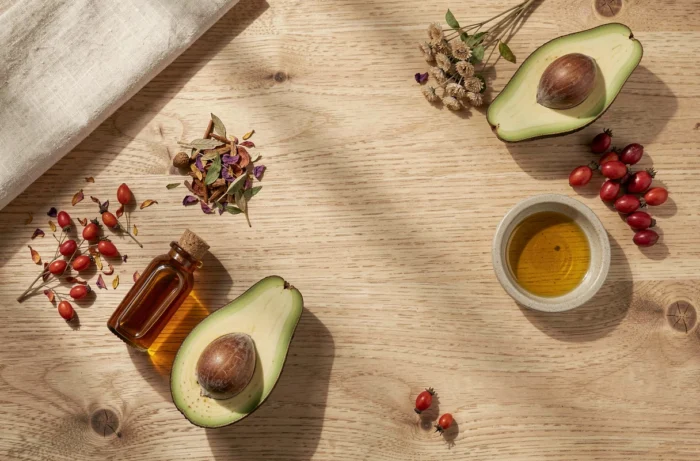
Prickly pear seed oil illustrates this nuance well. Rich in vitamin E and sterols, it offers notable antioxidant protection. The skin is better defended against oxidative stress, which slows down premature aging. But expecting it to erase deep wrinkles would confuse prevention with correction.
How to make the most of this antioxidant action
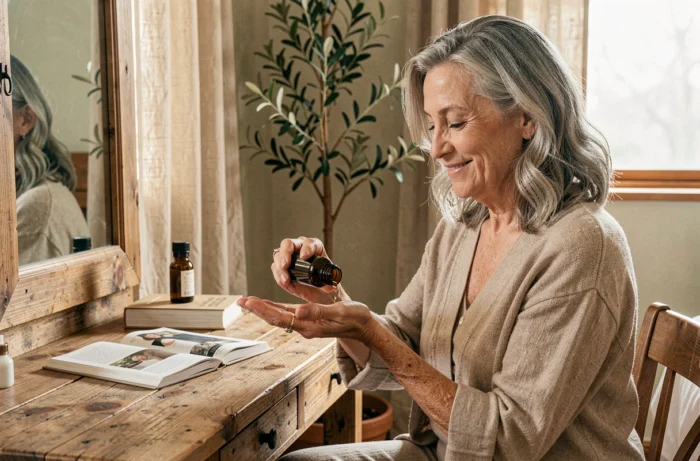
Apply the oil in the evening, on clean and slightly damp skin. The residual water helps the lipids penetrate the stratum corneum. Two to three drops are enough for the face. Beyond that, the excess remains on the surface without additional benefit.
If you are looking for comprehensive anti-aging effects, combine a vegetable oil with a serum containing a targeted active ingredient (vitamin C, retinol, hyaluronic acid). The oil comes as the last layer to seal in hydration and enhance the serum’s action.
Choosing a vegetable oil according to skin type: three profiles explained
Not all oils are suitable for all skin types. The difference lies in the proportion of fatty acids and the absorption rate.
Dry or dehydrated skin
Favor oils rich in oleic acid (omega 9), which are more nourishing and film-forming. Avocado or sweet almond oil creates a lasting protective film. These oils penetrate slowly: apply them in the evening to give the skin time to absorb them.
Combination to oily skin
Opt for oils dominated by linoleic acid (omega 6), which are lighter and less comedogenic. Jojoba oil regulates sebum because its composition mimics that of the hydrolipidic film. Hazelnut oil, very fluid, penetrates in seconds without leaving a greasy residue.
Sensitive or reactive skin
Oils rich in omega 3 calm redness and discomfort. Hemp seed oil, with a balanced omega 3/omega 6 ratio, soothes without clogging pores. Calendula oil is suitable for irritated or eczema-prone skin.
Labeling of cosmetic vegetable oils: what has changed recently
If you read the labels of your skincare products, you may have noticed that the INCI lists have become longer. This is not by chance.
European regulations now require each allergen exceeding a certain threshold in a leave-on product (face oil, serum, body lotion) to be listed individually. This threshold is set at 0.001%. For rinse-off products, it rises to 0.01%. Allergens from essential oils or aromatic extracts (limonene, linalool, geraniol) must be distinctly listed.
For so-called “100% natural” formulas based on vegetable and essential oils, this has a direct consequence: some have been reformulated, while others display much longer INCI lists than before.
Here are the points to check on a bottle:
- The mention “first cold press” or “virgin” guarantees a solvent-free extraction that preserves fatty acids and vitamins
- The absence of synthetic fragrance reduces the risk of allergy, especially on the face
- The presence of an organic label (Cosmos, Ecocert) certifies the origin of the raw materials and prohibits certain aggressive refining processes
Hemp oil as a makeup remover: a still little-known use
Vegetable oils are often used as treatments, rarely as cleansers. Hemp seed oil is an exception. Recent studies have validated its use as a stable and effective makeup remover base, in the form of a microemulsion.
The principle is simple: fatty substances dissolve makeup (including waterproof) better than water. A hemp oil formulated as a makeup remover rinses off without leaving an occlusive film, unlike pure oil. This dual use, for care and cleansing, makes hemp oil particularly versatile.
In France, the regulatory clarification around cosmetic hemp has removed ambiguities: products made from hemp seeds (without THC) are allowed and marketed without restriction.
The choice of a vegetable oil depends as much on your skin type as on the intended use. Restoring the skin barrier, calming reactive skin, gently removing makeup: each oil has a lipid profile that makes it more or less suitable. Reading the INCI list, identifying the dominant fatty acids, and testing on a small area remains the most reliable method to find the one that suits you.