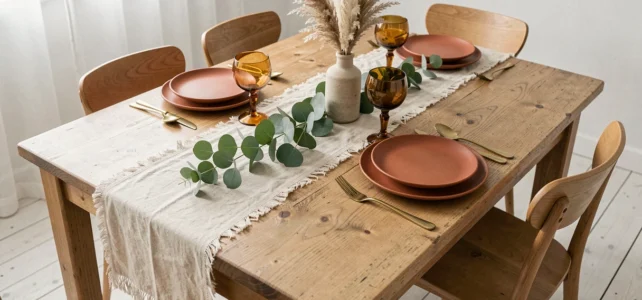
Choosing a plate, a glass, or a table runner is not trivial. These objects set the mood for a meal even before the first dish arrives. Trends in tableware and decoration evolve quickly, driven by aesthetic, ecological, and regulatory concerns that reshape what we place on our tables.
PFAS Regulation and Disposable Tableware: What Changes Really Mean
Have you ever used cardboard plates for a buffet or an outdoor party? Since August 12, 2026, the European regulation on packaging (PPWR, Regulation (EU) 2025/40) imposes very low thresholds for PFAS, these “forever chemicals,” in any food packaging that comes into direct contact with food.
The limits are strict: 25 ppb per individual PFAS, 250 ppb for the sum of PFAS, 50 ppm for total PFAS. The direct consequence is: cardboard plates, disposable sets, and takeout containers must be reformulated or removed. Manufacturers are required to obtain written confirmation from their suppliers certifying the absence of PFAS additives.
For individuals as well as for event professionals, this pushes towards reusable tableware. Ranges of stoneware, ceramic, or glass tableware are gaining ground against disposables. This is a sustainable shift that directly influences the style of tables, including for large festive gatherings or outdoor meals.
Browsing the tableware from La Table de Jeanne, one can clearly see this transition towards durable pieces that replace disposables without sacrificing aesthetics.
Artisanal Textures and Finishes: Why Touch Matters as Much as Visuals
Before discussing colors or patterns, let’s focus on a criterion often overlooked: texture. A raw stoneware plate does not produce the same sensation as a smooth porcelain one. This tactile contrast transforms the dining experience.
Reactive Glaze and Irregular Surfaces
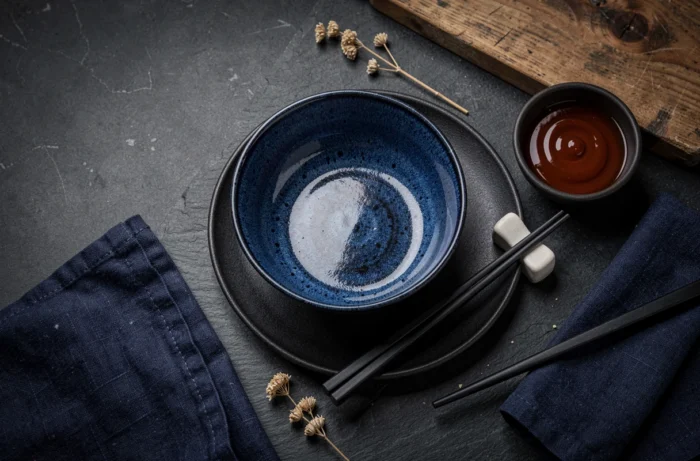
Reactive glaze, which creates unique variations in hue during firing, is prominent in recent collections. Each piece glazed reactively is a unique specimen, with gradients and depth effects that are impossible to reproduce identically on an industrial scale.
This type of finish works particularly well on flat plates and bowls. It brings an artisanal character without requiring handmade tableware (and the budget that comes with it).
Stoneware and Ceramic vs. Porcelain
Stoneware appeals with its robustness and raw appearance. Ceramic offers a broader palette of colors. Porcelain remains the reference for formal occasions. Rather than choosing a side, the current trend is to mix them on the same table:
- Thick stoneware presentation plates to anchor the decor in a natural register
- Fine porcelain dessert plates to create a contrast of weight and light
- Colorful ceramic bowls and dishes to punctuate the table with vibrant touches
Combining two or three materials on the same table adds depth without the effort of complex staging.
Color Palette: Beyond White and Terracotta
Earthy tones (beige, sand, terracotta) have dominated for several seasons. They remain a safe bet, but the palette is expanding into less expected directions.
Pastel Colors and Muted Shades
Recent collections incorporate powdery pinks, sage greens, and muted blues. These muted shades easily blend with each other and with wood, linen, or rattan. They are suitable for both everyday meals and festive tables.
Pastels work better in small touches than in total looks. Two tinted glasses, a colorful serving dish, or napkins in a soft hue are enough to transform the ambiance without overwhelming it.
Colored and Textured Glass
Glasses are no longer just transparent containers. Bubble, ribbed, or mass-tinted glass serves as a decorative accessory in its own right. A set of amber or olive green blown glass glasses adds a touch of color at eye level, where the gaze naturally rests during a meal.
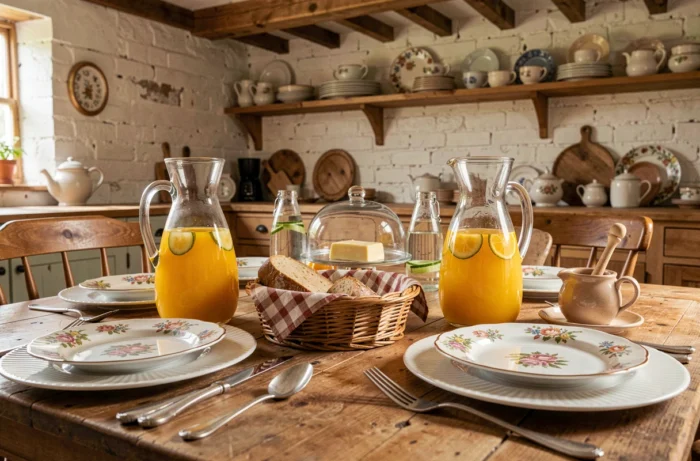
Table Decoration for Celebrations: Composing Without Accumulating
Christmas, birthdays, year-end meals: major occasions often push us to overdo it. The current trend goes in the opposite direction.
Why this choice? Because an overloaded table tires the eye and complicates service. A few well-chosen pieces make a stronger statement than an accumulation of details.
Here are the elements that make a difference on a festive table without turning it into a showcase:
- A table runner in raw linen or thick cotton, which sets the mood through its material rather than a pattern
- Candles of varying heights grouped in the center, rather than evenly spread out
- One or two plant elements (fir branches, eucalyptus, dried herbs) laid flat, without an imposing vase
- Wood or brushed brass accessories for details (napkin rings, place cards)
The most elegant style relies on a maximum of three materials: for example, linen, stoneware, and wood. Adding gold metal or vintage silverware can work, provided that the styles are not multiplied.
Asymmetrical Shapes and Character Pieces
Perfectly round plates and identical glasses are giving way to organic shapes. Slightly wavy edges, irregular oval dishes, or classic handleless cups bring movement to the table.
These character pieces do not need to be numerous. Just one serving dish with unusual lines is enough to break the symmetry and add visual interest. The rest can remain simple.
This approach aligns with a simple principle: invest in a few unique pieces rather than in a uniform complete set. A textured stoneware salad bowl, a ceramic pitcher with soft shapes, or a set of mismatched bowls can refresh the look of a table without replacing everything.
Trends in tableware and decoration converge towards a common thread: fewer pieces, better chosen, with materials that age well and regulations pushing disposables out. The table of tomorrow will be one where each object has been selected to last, not just to impress for a single evening.