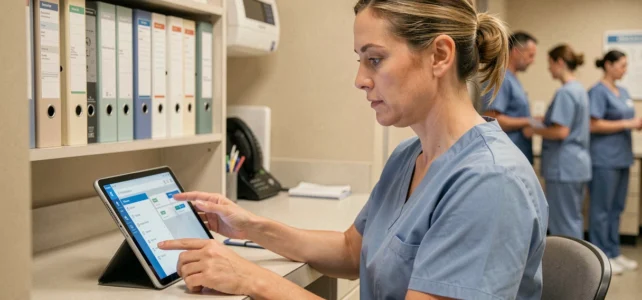
Netsoins is a software for electronic user file (DUI) deployed in the EHPADs of the Colisée group. It centralizes the administrative, medical, and paramedical data of each resident in a unique web interface. For the care teams, the transition to this tool changes the way care is tracked, clinical information is transmitted, and interventions are coordinated among nursing assistants, IDEs, IDECs, and coordinating doctors.
Generative AI and DUI Netsoins: what regulations prohibit since 2026
No competitor addresses this point, even though it directly concerns the caregivers who use Netsoins daily. There is a temptation to use a public AI tool to quickly draft a targeted transmission or a report. The legal framework is now explicit.
All content entered into the DUI is subject to the principle of respect for privacy and the confidentiality of information established by Article L.311-3 of the CASF. A report generated by a public AI tool cannot be directly entered into Netsoins: it must be reviewed and validated by an authorized professional, with each AI output being considered a proposal that may contain errors.
Colisée establishments are encouraged to explicitly prohibit the use of public AI tools for identifiable health data in their IT charter, except for integration into a secure channel (secure health messaging, DMP, dedicated digital space). In practice, a nursing assistant who drafts a transmission in Netsoins must do so manually or, if using a writing aid, ensure that the tool is hosted in an environment compliant with HDS and GDPR standards.
A user guide for Netsoins Colisée details the steps for entering and validating transmissions to meet these requirements.
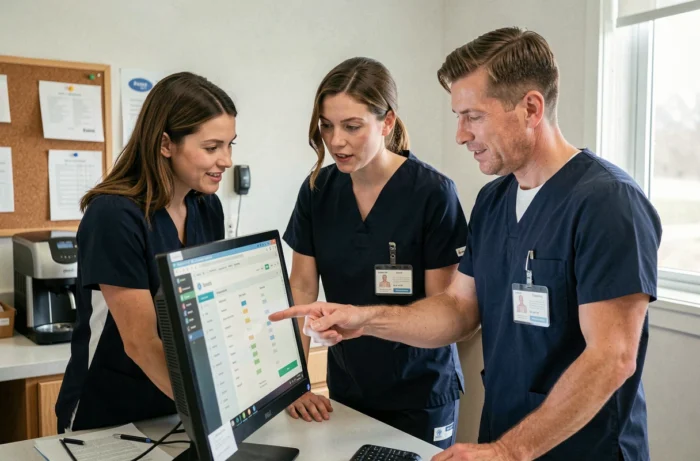
Digital Ségur Compliance: DUI Obligations for Colisée EHPADs
Netsoins is part of the digital ESMS program led by the CNSA and the ARS. The generalization phase launched in 2026 specifically concerns the child disability sector, but EHPADs remain subject to the requirements of the digital Ségur in health, which imposes interoperability of the DUI with the DMP and secure health messaging.
For Colisée care teams, this compliance has a direct practical consequence: the data entered in Netsoins can automatically feed the resident’s shared medical record. This means that the quality of each entry (completeness, wording, coding of actions) goes beyond the internal framework of the establishment.
A poorly drafted transmission or a poorly coded action in Netsoins can end up in the DMP accessible to the treating physician, the community pharmacist, or the hospital team in case of transfer. The accuracy of data entry in the DUI determines the quality of the care pathway beyond the walls of the EHPAD.
Netsoins and NETMobilité: traceability of care on the ground
NETMobilité is the mobile module of Netsoins, designed for professionals who work closely with the resident. On a tablet or smartphone, it allows for the entry of care actions, vital signs, and targeted transmissions directly in the room, without having to return to a fixed station.
What NETMobilité changes for the nursing assistant
Real-time data entry reduces the gap between the delivery of care and its traceability. With a paper notebook or deferred entry at the end of the shift, forgetfulness and approximations are common. NETMobilité eliminates this gap by allowing immediate validation of each action.
The module operates in connected mode. The nursing assistant opens the resident’s file, checks off the actions performed, adds an observation if necessary, and validates. The IDEC sees the update in real-time from their station.
Limitations to be aware of before deployment
- The establishment’s Wi-Fi coverage affects the reliability of NETMobilité. A dead zone in a corridor or on a floor leads to synchronization failures and data loss.
- The ergonomics on smartphones remain limited for long transmissions. Caregivers with small screens often prefer to return to the fixed station for multi-line texts.
- Managing access rights on shared devices poses a security issue: each caregiver must log out after use, which is not always respected in the urgency of care.
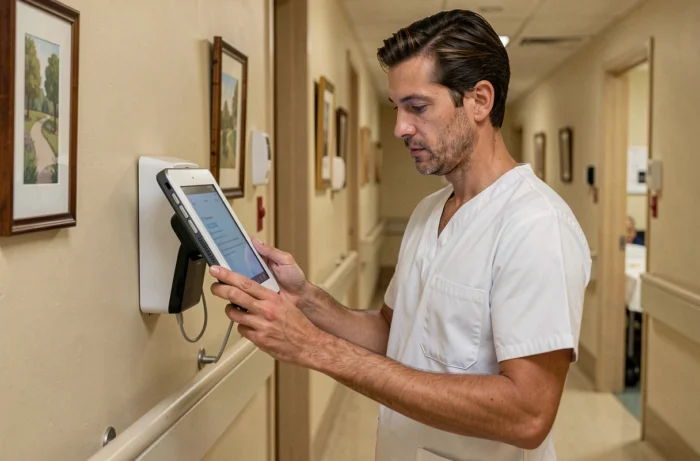
Document Management in Netsoins: archiving and access to resident documents
The DUI is not limited to transmissions and prescriptions. Netsoins includes a component of electronic document management (GED) that allows for archiving administrative documents, hospitalization reports, scanned prescriptions, and documents related to the resident’s life project.
For care teams, the challenge is to quickly find a document when needed. A transfer to the emergency room, for example, requires transmitting the latest medical report, the list of ongoing treatments, and advance directives. If these documents are properly classified in Netsoins, the IDEC can extract them in a few clicks. If they are scattered between a paper binder, an email inbox, and the DUI, the search time increases and the risk of forgetting rises.
The best practice is to digitize and integrate each document as soon as it is received, following the classification nomenclature defined by the establishment. A document not integrated into the DUI does not exist for the caregiver who needs it at 3 AM.
Transparency Indicators in EHPADs and the Role of the DUI
Recently, EHPADs must publicly disclose three indicators each year regarding staffing and quality of care. This data, intended to inform family choices, relies on the information consolidated in the establishment’s information system.
Netsoins, as a central DUI, serves as the primary source for several of these indicators. The completeness of resident files, the traceability of actions, and the updating of personalized projects directly feed the published data. For care teams, this reinforces the obligation for accuracy in daily data entry: each empty field or each untracked action potentially degrades the establishment’s indicators.
The DUI is no longer just an internal coordination tool. It becomes an instrument of public accountability, which changes the perception caregivers may have of their data entry work.